

Climate Resilient Sanitation
Climate change is a significant challenge for sanitation service provision, also in humanitarian contexts and particularly in extreme heat, water-stressed or flood-prone regions. Sanitation services which are not designed to function under changing climate conditions, or which are not operated accordingly can cause health risks and contamination when affected by climate hazards. By integrating measures for mainstreaming climate change adaptation and greenhouse gas (GHG) mitigation into sanitation services on practical and policy level, more resilient systems can be created that benefit communities and their surrounding living environment and contribute to global climate goals.
Key Actions
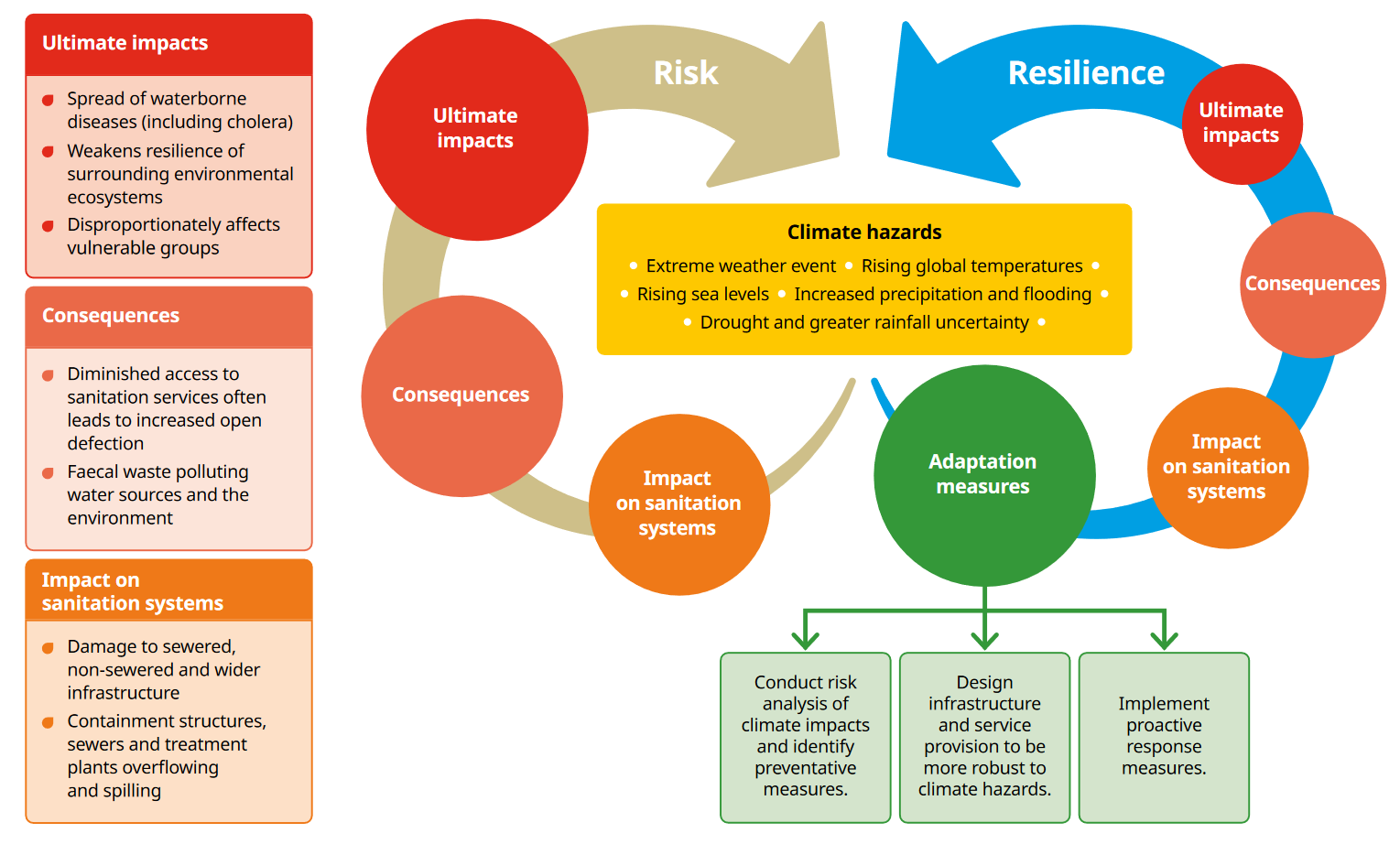
As shown on the illustration below, without adaptation measures, climate change has undiminished negative impacts and consequences on affected sanitation services, communities and the living environment (risk arrow, left side). However, if adaptation measures are taken into account, the negative impacts can be significantly reduced (resilienceResilienceAbility of all key sanitation stakeholders to prevent, resist, absorb, adapt, respond and recover positively, efficiently and effectively when faced with a wide range of risks, while maintaining an acceptable level of WASH system performance without compromising long-term… arrow, right side).
(WaterAid, 2023)
The three green boxes shown under adaptation measures in the illustration summarizes common steps to identify and develop effective adaptation measures. The aim of these steps is to take climate risks into account in the provision of sanitation services during systems planning, construction or rehabilitation and operation, and thus make them more climate-resilient. Similar steps are widely applied in key guidelines and tools for climate mainstreaming and are further described below.
- Analyse climate risks to identify the potential impact of climate and extreme weather events including potential hazard and the exposure, vulnerability and capacity to respond of communities. Based on the potential hazards preventive measures are identified to mitigate risks.
- Design more climate resilient systems and services as e.g., climate resilient system layouts, anticipatory actions to reduce the risk of sanitation systemSanitation SystemA sanitation system is a context-specific set of technologies, which in combination manage sanitation products from the point of generation to the point of use or ultimate disposal along the five functional groups of the sanitation service chain. A viable system is one that is… failures as well as preventive and preparedness measures. Consider also anticipatory action that includes capacity and funding to forecast, manage and respond to climate shocksShocksShort term deviations with substantial negative effects on people’s current state of wellbeing, level of assets, livelihoods, safety or ability and capacity to withstand future shocks. while ensuring minimal disruption to services.
- Implement proactive response measures by implementing revised layouts of sanitation systems to improve their reliability, robustness and responsiveness to seasonal variability (e.g., extreme heat, droughts or floods) and extreme weather events to minimise possible effects and to allow quick recovery after a shock. The measures are taken into account when building new systems and when rehabilitating existing systems (build back better). Where possible include emission reduction e.g., by capturing biogasBiogasCommon name for the mixture of gases released from the anaerobic digestion of organic material. Biogas comprises methane (50 to 75 %), carbon dioxide (25 to 50 %) and varying quantities of nitrogen, hydrogen sulphide, water vapour and other components, depending on the material… and effective wastewaterWastewaterUsed water from any combination of domestic, industrial, commercial or agricultural activities, surface runoff/stormwater, and any sewer inflow/infiltration. treatment, water reused or use of renewable energies or nature-based solutions.
For mainstreaming climate resilienceResilienceAbility of all key sanitation stakeholders to prevent, resist, absorb, adapt, respond and recover positively, efficiently and effectively when faced with a wide range of risks, while maintaining an acceptable level of WASH system performance without compromising long-term… into sanitation provision various tools and guidelines are available. A selection is listed under Key Resources and Tools.
Relevance/Importance
Climate-resilient sanitation needs not only to adapt to changing climate conditions but should also contribute to mitigate GHG emissions. In this way it enhances people’s health, the resilienceResilienceAbility of all key sanitation stakeholders to prevent, resist, absorb, adapt, respond and recover positively, efficiently and effectively when faced with a wide range of risks, while maintaining an acceptable level of WASH system performance without compromising long-term… of communities, and it contributes to a sustainable living environment.
- Adaptation to changing climate : Climate-related changes in water availability often have a negative impact on sanitation systems. Extreme heat can negatively impact functioning of user interfaceUser InterfaceA term used to describe the type of toilet, pedestal, pan, or urinal that the user comes into contact with; it is the way users access the sanitation system. In many cases, the choice of user interface will depend on the availability of water and on user preferences./containment (e.g. limiting microbial growth in compostingCompostingThe process by which biodegradable components are biologically decomposed by microorganisms (mainly bacteria and fungi) under controlled aerobic conditions. toiletToiletA sanitation facility (or ‘user interface’) used for urination and defecation. Often interchangeably referred to as latrine. or worms in vermicompost toilets); sewerSewerAn open channel or closed pipe used to convey sewage. system through corrosion due to increased production of hydrogen sulphide and biological treatment processes. Flooding, for instance, can impact the functionality of onsite sanitation systems or even destroy them and contaminate water resources. Flooding could impact drainageDrainageDrainage refers to the process of removing excess water from an area and its transport to another location. and transport systems, preventing service vehicles accessing onsite sanitation systems to empty their contents; sewerSewerAn open channel or closed pipe used to convey sewage. overflows and damage to treatment facilities (typically located in low lying areas near to water bodies. Water stress can also lead to systems dysfunction, affecting water quality and availability. It can then render systems inoperative and force communities back to practices like open defecationOpen DefecationPractice of defecating outside in the open environment..
- Health and contamination risks: Sanitation systems, impacted by climate hazards as flooding or drought, impose significant health and contamination risk. People most affected are poor families, women, girls and persons with disabilities.
- Mitigation to climate change: Sanitation systems contribute a significant amount of GHG emissions and by adopting climate-resilient approaches the sanitation sector can contribute to the global climate goals. Simple examples are the substitution of fossil fuels by renewable energy sources, reduction of methaneMethaneA colourless, odourless, flammable, gaseous hydrocarbon with the chemical formula CH4. Methane is present in natural gas and is the main component (50–75%) of biogas that is formed by the anaerobic decomposition of organic matter. emissions from septicSepticDescribes the conditions under which putrefaction and anaerobic digestion take place. tanks or a local low-emission procurement.
Overview
An increasing number of people live in extreme heat, water stressed or flood-prone areas, a problem that is rapidly increasing as a result of climate change. Households that have gained access to basic or safely managed sanitation systems risk losing them in the event of climate-related disasters, changing climate patterns and sea level rise if due care is not taken in the planning and development of such systems and consideration is not given to mitigating potential risks and shocksShocksShort term deviations with substantial negative effects on people’s current state of wellbeing, level of assets, livelihoods, safety or ability and capacity to withstand future shocks.. Access to sanitation is a human right. It provides benefits across society in improved health as well as economic and social development. Making sanitation resilient is in the best interest of everybody. According to Intergovernmental Panel on Climate Change (IPCC), key sanitation infrastructure systems will be increasingly vulnerable if design standards do not account for changing climate conditions. Non-climate-resilient sanitation services pose a substantial public health hazard. During more frequent and severe flooding, damaged toilets and sanitation systems have spread disease across entire communities. In drought-affected areas, non-resilient sanitation systems can exacerbate water stress or cease to function, causing families to revert to open defecationOpen DefecationPractice of defecating outside in the open environment.. This impact is greatest on the most vulnerable individuals, especially women and girlsWomen and GirlsThe term includes women with disabilities, women from different economic and educational backgrounds, women of diverse sexualities, transgender women, and women from different racial, ethnic, and religious backgrounds. and persons with disabilities. Unless urgent actions are taken, the impact of climate change is set to undermine decades of progress in the sanitation sector. Systems and services must be made resilient to protect investments, promote public health and ensure universal access to sustainable, equitable and safe sanitation for all. Furthermore, safe use of sanitation wastewaterWastewaterUsed water from any combination of domestic, industrial, commercial or agricultural activities, surface runoff/stormwater, and any sewer inflow/infiltration. and sludgeSludgeMixture of solids and liquids, containing mostly excreta and water, in combination with sand, grit, metals, trash and/or various chemical compounds. A distinction can be made between faecal sludge and wastewater sludge. Faecal sludge comes from on-site sanitation technologies,… from sanitation systems for irrigation and energy recovery has a large unmet potential to contribute to adaptation and mitigation in the agriculture and energy sectors. A study (UNICEF, 2020) estimated that $105 billion per year is needed to achieve the sanitation component of SDG target 6.2 by 2030 and additional amounts are required to adapt to impact of climate change. Sanitation especially is often underfunded at the country level and is failing to take advantage of climate funding opportunities, with less than 1% of major climate funding being allocated to the sanitation sector. Emissions from sanitation systems are often underestimated, and global estimates do not always consider the non-sewered sanitation systems which are prevalent in rapidly growing cities in low-and middle-income countries. The global methaneMethaneA colourless, odourless, flammable, gaseous hydrocarbon with the chemical formula CH4. Methane is present in natural gas and is the main component (50–75%) of biogas that is formed by the anaerobic decomposition of organic matter. emissions from non-sewered sanitation systems in 2020 was estimated at 4.7% of global anthropogenic methaneMethaneA colourless, odourless, flammable, gaseous hydrocarbon with the chemical formula CH4. Methane is present in natural gas and is the main component (50–75%) of biogas that is formed by the anaerobic decomposition of organic matter. emissions, which are comparable to the GHG emissions from wastewaterWastewaterUsed water from any combination of domestic, industrial, commercial or agricultural activities, surface runoff/stormwater, and any sewer inflow/infiltration. treatment plants (Cheng S. et al., 2022). A recent study found that in an African city, sanitation systems may account for as much as half of all city-level emissions. Yet approaches to balance cost effective access to resilient sanitation for all and lower emissions are not yet clear and projects to mitigate these emissions remain small in number. The sanitation sector in most countries must be supported to put emphasis on climate adaptation and mitigation and the opportunities for building resilienceResilienceAbility of all key sanitation stakeholders to prevent, resist, absorb, adapt, respond and recover positively, efficiently and effectively when faced with a wide range of risks, while maintaining an acceptable level of WASH system performance without compromising long-term… or achieving mitigation goals are incorporated as part of routine programming. There is an urgent need for the sector partners to mainstream adaptation and mitigation measures in sanitation programming. (Climate Resilient Sanitation Coalition, 2022)
Author
Thorsten Reckerzügl (German Toilet Organization (GTO))
Reviewers
Sara Ubbiali (Swiss Federal Institute of Aquatic Science and Technology (Eawag)), Shirish Singh (IHE Delft Institute for Water Education)
Bibliography
- The Overlooked Solution - Strengthening Climate Resilience through Sanitation Systems
- Programme Guidance for Climate Resilient WASH
- Ensuring Access to Climate-Resilient Sanitation Services for 3.6 Billion People by 2030: A Call to Action for Acceleration
- Non-negligible Greenhouse Gas Emissions From Non-sewered Sanitation Systems: A Meta-Analysis
- Global and Regional Costs of Achieving Universal Access to Sanitation to Meet SDG Target 6.2