


Water Supply
Water is essential to life, health and dignity and access to it is a basic human right. In emergency responses, it is critical to provide water supply services, to reduce mortality and morbidity, and enhance protection, dignity and quality of life of affected population.
Relevance/Importance
The right to water is part of the universal rights essential for human survival and dignity, entitling every individual to sufficient, safe, accessible water for personal and domestic uses. This right is critical in emergencies, where vulnerabilities are intensified and the risks of waterborne diseases increase. People affected by crises are susceptible to illness and death from disease, particularly diarrhoeal and infectious diseases, which is directly related to inadequate and unsafe water supply.
Safe water is essential to:
- sustain life, health and dignity;
- prevent death from dehydration;
- reduce the risk of WASH-related diseases; and
- allow for adequate consumption, cooking, and personal and domestic hygienic requirements.
Overview
Access to water is essential to human health and well-being, and recognised as a basic human right. This right entitles everyone to have access to sufficient, safe, acceptable, physically accessible and affordable water for both personal and domestic uses. This right applies to all contexts of an emergency, transcending geographical and temporal considerations. In response to emergencies, there exist tailored standards and guidelines dedicated to ensuring both quantity and quality of water. These guide the efforts for meeting this right of access to water and include the Sphere project’s minimum standards for all emergency types and phases as well as specific standards for internally and internationally displaced people by UNHCR, the WHO guidelines for drinking water, and existing national standards and guidelines.
However, national water standards are not always adaptable for crisis situations, so it may not be appropriate or feasible to follow existing standards. If national
emergency guidelines are not specific or existent; the Sphere Humanitarian Charter and Minimum Standards in Humanitarian Response should be referred to for guidance (or UNHCR indicatorsIndicatorsIndicators are the ‘signals’ that enable measurement of progress and objectives and therefore of change. and targets in refugee settings), which need to be further adapted based on context, response phase and existing national targets.
The main objective of water supply programmes in humanitarian response is to reduce public health risks by creating barriers along the pathways of pathogenPathogenAn organism or other agent that causes disease. transmission. Integrated water and sanitation management should meet human needs and protect the ecosystem. Key objectives for water supply are:
- People have equitable and affordable access to a sufficient quantity of safe water to meet their drinking and domestic needs;
- Water is palatable and of sufficient quality for drinking and cooking and for personal and domestic hygiene without causing a risk to health;
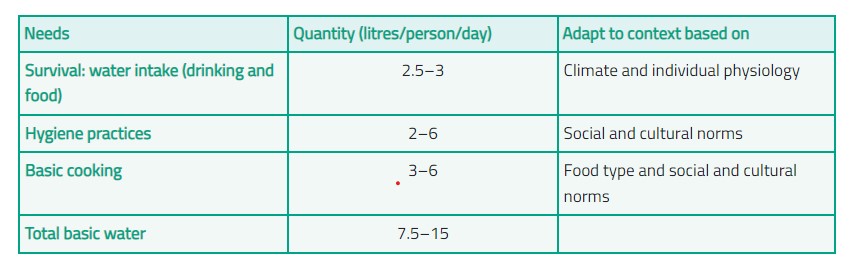
The priority is to provide adequate quantity of water, even if its safety cannot be guaranteed, and to protect water sources from contamination. A minimum of 15 litres per person per day should be provided as soon as possible and in extreme cases and short periods, the minimum is 7.5 litres per person per day (see table below).
During acuter response, people may use an untreated water source for laundry, bathing, etc, however, longer term plans and water-quality improvements should be made for the stabilisationStabilisationThe degradation of organic matter with the goal of reducing readily biodegradable compounds to lessen environmental impacts (e.g. oxygen depletion, nutrient leaching). and recovery phases.
Key Actions
- Conduct a water supply needs assessment (for details please refer Sphere Standards Appendix 1: Water supply, sanitation and hygiene promotion initial needs assessment checklist and Needs assessment and analysis).
- Identify the most appropriate water sources considering potential environmental impacts (pay attention to seasonal variations in water supply and demand as well as distribution mechanism). Collaborative efforts with local stakeholders are crucial for selecting and managing water sources.
- Determine how much water is required (for details please refer to Sphere Standards Appendix 3: Minimum water quantities: survival figures and quantifying water needs) and the systems needed to deliver it. Plan delivery systems that are equitable and sustainable engaging with stakeholders to locate water points and establish operation and maintenanceOperation and MaintenanceRoutine or periodic tasks required to keep a sanitation process or system functioning according to performance requirements and to prevent delays, repairs or downtime. systems with clear roles and responsibilities.
- Determine the most appropriate method for ensuring safe drinking water at point(s) of consumption or use (treatment options include bulk water treatment and distribution, with safe collection and storage at the household level, or household-level water treatment and safe storage).
- Engage communities and other stakeholders in planning and implementing, enhancing control over the response impact and ensuring sustainability.
- Explore possibility of market or cash-based assistance, particularly in urban contexts, which can efficiently and effectively meet water needs.
Note:
- Oxfam webpage on water, is helpful to plan and provide a quick and reliable water supply for affected populations.
- Compendium of Water Supply Technologies in Emergencies is helpful to plan and design the water supply system.
Additionally, it is required to
- Ensure appropriate waterpoint drainageDrainageDrainage refers to the process of removing excess water from an area and its transport to another location. at household and communal washing, bathing and cooking areas and handwashing facilities.
- Identify public health risks associated with the water available and the most appropriate way to reduce them (protect water sources).
Author
Shirish Singh (IHE Delft Institute for Water Education)
Reviewer
Sara Ubbiali (Swiss Federal Institute of Aquatic Science and Technology (Eawag))
Bibliography
- The Sphere Handbook: Humanitarian Charter and Minimum Standards in Humanitarian Response
- Compendium of Water Supply Technologies in Emergencies