Faecal Sludge Field Lab (FSFL)
The Faecal Sludge Field Laboratory (FSFL) enables on-site process and effluent quality control of faecal sludge and wastewater treatment plants. It produces results comparable to a standard laboratory but is designed to operate under field conditions (e.g. with no power supply). Equipment lists, manuals and training materials are all available as open-source resources. To find more information visit the FSFL website or email the Austrian Red Cross (fsm@redcross.at) for assistance.
Key Actions
- Browse through the open source FSFL website. It includes all the relevant manuals and equipment lists to help and guide decision-making.
- Contact the Austrian Red Cross via fsm@redcross.at if you require guidance on the procurement process, are unsure which modules to procure or would simply like to get more detailed information based on field experience.
- Go online and procure selected (or all) equipment listed or contact a trusted supplier (the contacts of suppliers who have previously delivered all the lab equipment required are available).
- Inform yourself about the customs of the country where the FSFL will be used (ask the Austrian Red Cross about the potential traps).
- Plan your training with the resources available (e.g. training manual) or contact the Austrian Red Cross for support.
- Plan your data management system carefully (again, the Austrian Red Cross is happy to share experiences).
- Plan for the safe management of (hazardous!) waste in accordance with national regulations and international standards.
- Ensure the FSFL’s uninterrupted operation by the timely re-stocking of consumables and by training enough people on the job.
Relevance/Importance
The increase in urban disasters, protracted crises and mega camps requires faecal sludgeSludgeMixture of solids and liquids, containing mostly excreta and water, in combination with sand, grit, metals, trash and/or various chemical compounds. A distinction can be made between faecal sludge and wastewater sludge. Faecal sludge comes from on-site sanitation technologies,… management solutions for emergencies to safeguard people’s health and the environment. The FSFL enables the timely monitoringMonitoringMeasures progress and checks whether a programme or intervention is working according to plan. It is the planned, systematic and continuous checking of a sanitation intervention to ensure it is doing what was intended, that allocated funds are being used effectively, that… of a wide range of public health and process parameters to control/improve on-site treatment performance. As a result, it ensures that treatment solutions established during emergency response operations are working properly and meet corresponding standards.
Unlike a standard laboratory, the FSFL is designed to operate under field conditions (e.g. with no power supply), be mobile (fit into a Toyota Landcruiser), remain affordable (cheaper than standard lab solutions) and be appropriate (deliver results comparable to those of a standard lab).
Overview
The FSFL is organised into two main and three support equipment modules. The main modules are “Public Health” and “Process Control”. The support modules are “Basic Laboratory Support”, “Personal Protection” and “Power Supply”.
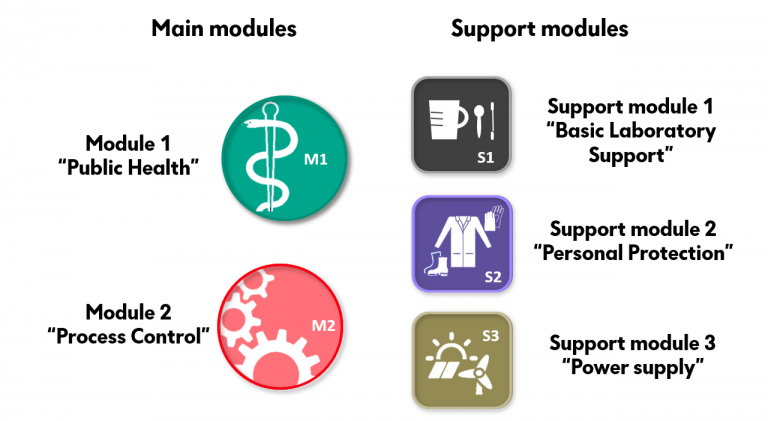
Overview of FSFL Modules (Source: Austrian Red Cross)
Information, such as equipment lists and manuals, provided on the FSFL website allows users to decide which equipment is required in each specific case (e.g. equipment required for bacteriological analysis is included in the public health module while equipment for measuring chemical oxygen demandChemical Oxygen DemandA measure of the amount of oxygen required for chemical oxidation of organic material in water by a strong chemical oxidant (expressed in mg/L). COD is always equal to or higher than BOD since it is the total oxygen required for complete oxidation. It is an indirect measure of… is in the process control module). The Austrian Red Cross team is happy to assist in the decision-making process as not all parameters need monitoringMonitoringMeasures progress and checks whether a programme or intervention is working according to plan. It is the planned, systematic and continuous checking of a sanitation intervention to ensure it is doing what was intended, that allocated funds are being used effectively, that… in every setting and some supplies might already be in place or available locally.
Module 1: Public Health
Protecting public health is a primary purpose of faecal sludgeSludgeMixture of solids and liquids, containing mostly excreta and water, in combination with sand, grit, metals, trash and/or various chemical compounds. A distinction can be made between faecal sludge and wastewater sludge. Faecal sludge comes from on-site sanitation technologies,… management, especially in emergency settings. The public health module is hence considered a core pillar of the laboratory. This module includes equipment to determine degradation levels of indicator organisms throughout faecal sludgeSludgeMixture of solids and liquids, containing mostly excreta and water, in combination with sand, grit, metals, trash and/or various chemical compounds. A distinction can be made between faecal sludge and wastewater sludge. Faecal sludge comes from on-site sanitation technologies,… treatment plants. The equipment can quantitatively detect the following parameters: E. coli, Enterococcus sp. & Salmonella sp. (all through the compact dry plate method) as well as HelminthHelminthA parasitic worm, i.e. one that lives in or on its host, causing damage. Some examples that infect humans are roundworms (e.g., Ascaris and hookworm) and tapeworms. The infective eggs of helminths can be found in excreta, wastewater and sludge. They are very resistant to… eggs (through the FLOTAC method and microscopy). The manual includes all aspects of bacteriological analysis from how to produce the necessary working solution through to plating and counting.
Module 2: Process Control
This module considers a variety of different treatment processes. In emergency aid operations, where the treatment sequence of the plant(s) is often unknown, equipment supporting analysis of the full range of possible parameters should be included in the kit. In non-emergency settings, the equipment included should be adapted to measure the parameters relevant to the specific treatment sequence only.
Support Module 1: Basic Laboratory Support
This module adds equipment that makes the FSFL a full field laboratory, rather than simply an analysis kit. The additions (everything from an autoclave to a UV pen or scissors) are essential to ensure that, at the start of an emergency, the FSFL hits the ground running.
Support Module 2: Personal Protective EquipmentPersonal Protective EquipmentProtective clothing including boots, masks, gloves, apron, etc. or other garments or equipment designed to protect the wearer's body from injury or infection from sanitation products.
Personal protective equipmentPersonal Protective EquipmentProtective clothing including boots, masks, gloves, apron, etc. or other garments or equipment designed to protect the wearer's body from injury or infection from sanitation products. is important to safeguard the health of laboratory technicians from the start (see also: Health and Safety of Operators and Workers).
Support Module 3: Power Supply
This module adds an uninterruptible power supply (UPS). A photovoltaic panel and a wind turbine have been added to charge the UPS batteries independently from fossil fuel generators.
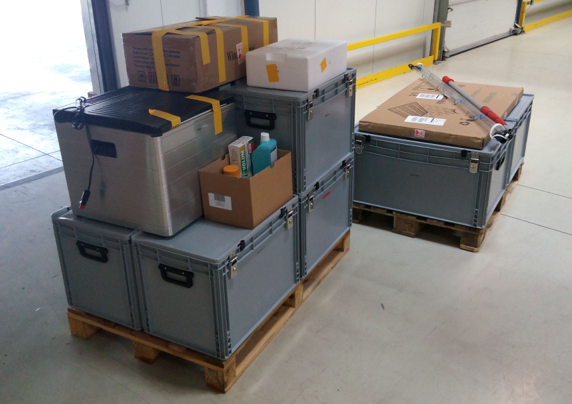
Complete FSFL Kit (source: Austrian Red Cross)
Contexts in which the FSFL is, or has been, used include: serving host and refugee communities during Red Cross Red Crescent operations in Bangladesh and Uganda, supporting Doctors without Borders in Haiti, enabling the German Red Cross to control the treatment of wastewaterWastewaterUsed water from any combination of domestic, industrial, commercial or agricultural activities, surface runoff/stormwater, and any sewer inflow/infiltration. during a flooding response in their own country or – using adapted versions - supporting the Veolia Foundation as well as Swiss Humanitarian Aid in their training and deployments.
Author
WASH Service Center of the Austrian Red Cross
Reviewers
Bangladesh Red Crescent Society, Butyl Products Ltd, Eawag, Elrha - Humanitarian Innovation Fund (HIF), International Federation of Red Cross and Red Crescent Societies (IFRC), Swiss Agency for Development and Cooperation, Swiss Humanitarian Aid, Uganda Red Cross Society, University of Natural Resources and Life Sciences Vienna, WASTE
Bibliography
- Faecal Sludge Field Laboratory (adapted from)