


Humanitarian Development and Peace Nexus (Triple Nexus)
The Humanitarian, Development and Peace (HDP) Nexus or Triple Nexus is the term used to capture the interlinkages between the humanitarian, development and peace sectors. In contexts vulnerable to conflict and disasters, the HDP nexus seeks to strengthen the resilience of sanitation systems and relevant hygiene practices, thereby reducing humanitarian needs and advancing sustainable development at the same time. In fragile or conflict affected settings, inclusive water and sanitation services, ideally area-wide and on household level, can strengthen social cohesion and promote peace. In contrast to existing isolated approaches that have proven not to work in fragile contexts, this approach aims to enable successful collaboration between humanitarian, development and peace actors.
Key Actions
Following the steps defined in the JOF, consistent with the steps in the IASC Light Guidance on Collective Outcomes:Collective outcomesCommonly agreed measurable result(s) or impact(s) enhanced by the combined effort of different actors, within their respective mandates, to address and reduce people’s unmet needs, risks and vulnerabilities, increasing their resilience and addressing the root causes of conflict”…
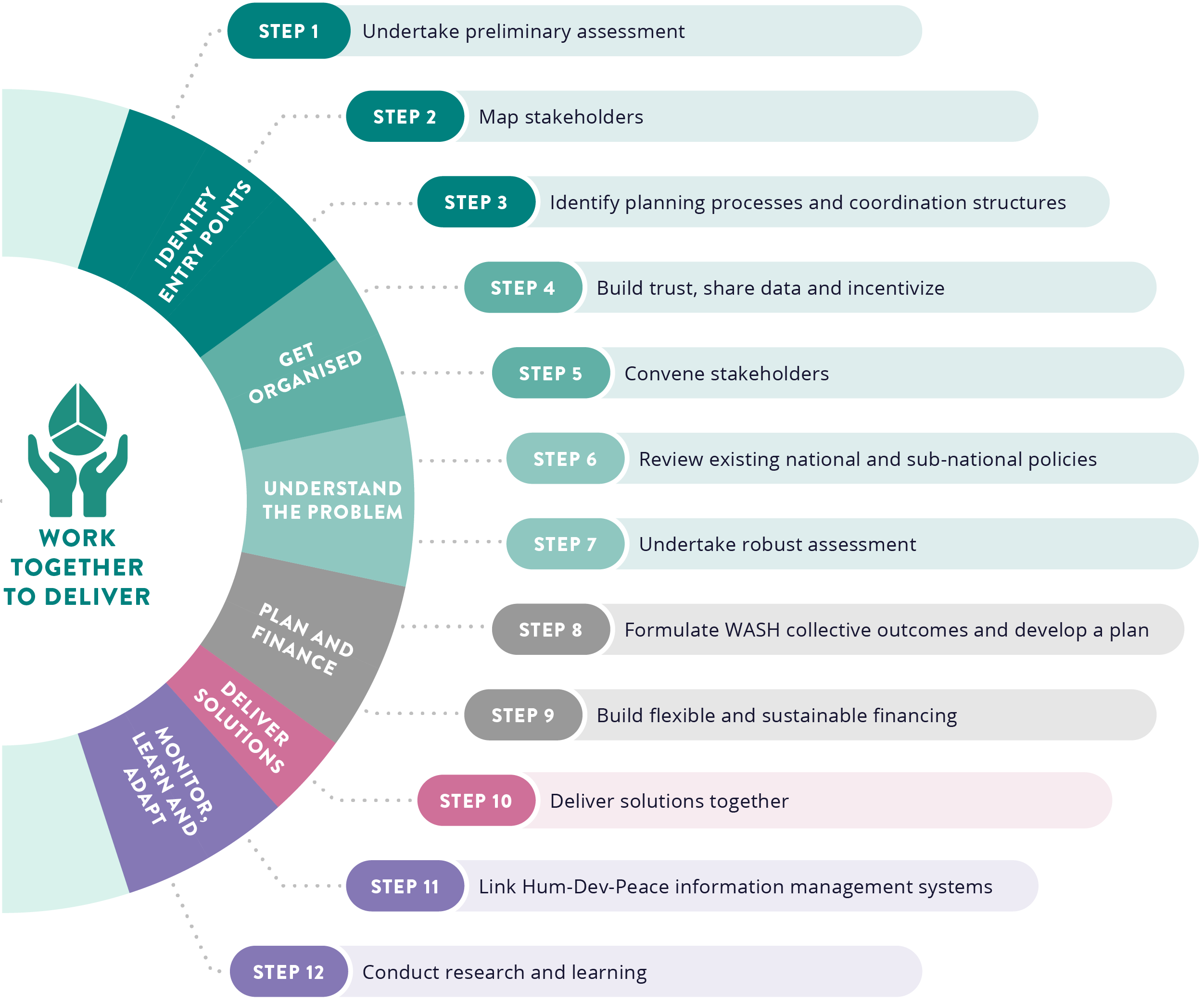
- Step 1 - Conduct a preliminary assessment to identify WASH needs, risks, and vulnerabilities: Prior to initiating a nexus collaboration, a preliminary assessment should be undertaken to determine the key needs, vulnerabilities, and risks faced by the targeted population.
- Step 2 - Conduct stakeholder mapping to determine suitable partners for collaboration: To build a collaboration, actors need to gain an understanding of potential partners in the sector. A stakeholder mapping exercise will identify which actors operate within a given geographic area and with which mandate(s) (USAID 2021). The analysis can draw on WASH coordination bodies and stakeholders of other sectors like IWRM, health or peacebuildingPeacebuildingCapacity to “reduce the risk of a lapse or relapse into violent conflict by directly addressing root causes and consequences of conflict,” and to address conflict and “lay and support foundations for sustainable peace and development”. Skip this step, if stakeholders are already well known through existing networks.
- Step 3 - Identify most suitable planning process and coordination structures to launch collaboration: A joint coordination platform should be identified to support a planning process based on achieving collective outcomesCollective outcomesCommonly agreed measurable result(s) or impact(s) enhanced by the combined effort of different actors, within their respective mandates, to address and reduce people’s unmet needs, risks and vulnerabilities, increasing their resilience and addressing the root causes of conflict”…. Ideally this will be an existing local structure with a trusted leadership. In many cases, the government, the UN and other bodies have established coordination mechanisms and information management systems in protracted and recurrent crisis settings (IASC 2020a).
- Step 4 - Build trust, share data, and incentivise: Collaboration is based on trust. Therefore, ensure that sufficient incentives for collaboration are provided. Networking and information sharing is a good place to start. Trust is built over time, with higher levels of collaboration achieved when resources, assessments, planning processes and capacity building are well coordinated or shared.
- Step 5 - Convene stakeholders, determine roles and responsibilities: In order to determine the best fit for collaboration, a transparent process for evaluating the comparative advantage of each potential partner is recommended. This is a sensitive process that will require the trust of partners. It includes the evaluationEvaluationThe systematic and objective examination of a humanitarian intervention to determine the worth or significance of an activity, policy or programme and intended to draw lessons to improve policy and practice and enhance accountability. The key evaluation criteria are relevance,… of mandates, experiences and capacities of each potential actor and to formalise collaboration with defined roles and responsibilities.
- Step 6 - Review existing national and subnational priorities: An assessment of the links between sanitation priorities, resilienceResilienceAbility of all key sanitation stakeholders to prevent, resist, absorb, adapt, respond and recover positively, efficiently and effectively when faced with a wide range of risks, while maintaining an acceptable level of WASH system performance without compromising long-term… and peacebuildingPeacebuildingCapacity to “reduce the risk of a lapse or relapse into violent conflict by directly addressing root causes and consequences of conflict,” and to address conflict and “lay and support foundations for sustainable peace and development”, is useful in identifying synergies, finding opportunities for strengthening them and proposing entry points for collective outcomesCollective outcomesCommonly agreed measurable result(s) or impact(s) enhanced by the combined effort of different actors, within their respective mandates, to address and reduce people’s unmet needs, risks and vulnerabilities, increasing their resilience and addressing the root causes of conflict”… to be enhanced by collaboration with other sectors, like health, food or WRM. Both government planning, budgeting processes and reviews as well as UN cooperation frameworks (e.g., UNSDCF) are important entry points.
- Step 7 - Conduct a robust joint assessment of WASH context, risks and needs: A joint assessment of WASH context, risks (including conflict), and needs is crucial for resilienceResilienceAbility of all key sanitation stakeholders to prevent, resist, absorb, adapt, respond and recover positively, efficiently and effectively when faced with a wide range of risks, while maintaining an acceptable level of WASH system performance without compromising long-term…, conflict sensitivityConflict sensitivityAbility of a sanitation agencies to understand its operating context, the interaction between its interventions and the context, and act upon this understanding to avoid negative impacts (“do no harm”) and maximise positive impacts on conflict factors ( UNICEF 2020, IASC 2020b)., and peacebuildingPeacebuildingCapacity to “reduce the risk of a lapse or relapse into violent conflict by directly addressing root causes and consequences of conflict,” and to address conflict and “lay and support foundations for sustainable peace and development”. Tools like environmental and social impact assessments are increasingly recognized as best practices by development banks, donors, and the UN.
- Step 8 - Formulate collective outcomesCollective outcomesCommonly agreed measurable result(s) or impact(s) enhanced by the combined effort of different actors, within their respective mandates, to address and reduce people’s unmet needs, risks and vulnerabilities, increasing their resilience and addressing the root causes of conflict”… and develop a joint plan: A joint definition of the sanitation problems, including clear terms for resilienceResilienceAbility of all key sanitation stakeholders to prevent, resist, absorb, adapt, respond and recover positively, efficiently and effectively when faced with a wide range of risks, while maintaining an acceptable level of WASH system performance without compromising long-term…, conflict sensitivityConflict sensitivityAbility of a sanitation agencies to understand its operating context, the interaction between its interventions and the context, and act upon this understanding to avoid negative impacts (“do no harm”) and maximise positive impacts on conflict factors ( UNICEF 2020, IASC 2020b)., and peacebuildingPeacebuildingCapacity to “reduce the risk of a lapse or relapse into violent conflict by directly addressing root causes and consequences of conflict,” and to address conflict and “lay and support foundations for sustainable peace and development”, ensures stakeholder clarity on required capacities (e.g., for floods, conflict, or climate change) and target beneficiaries (e.g., households, communities, or governments). Collective WASH outcomes should align with these definitions, span 3–5 years or more, and use the SMART framework. A joint plan or results framework should include a context-specific Theory of Change, explicit assumptions and risks, and clearly assigned responsibilities for outputs and outcomes.
- Step 9 - Build flexible and sustainable WASH financing: Analyzing the financing landscape and integrating WASH resilienceResilienceAbility of all key sanitation stakeholders to prevent, resist, absorb, adapt, respond and recover positively, efficiently and effectively when faced with a wide range of risks, while maintaining an acceptable level of WASH system performance without compromising long-term… into national strategies is essential for developing multi-year, flexible mechanisms leveraging IFIs, commercial banks, and MFIs. Key measures include de-risking WASH providers through improved creditworthiness and financial management, fostering resilienceResilienceAbility of all key sanitation stakeholders to prevent, resist, absorb, adapt, respond and recover positively, efficiently and effectively when faced with a wide range of risks, while maintaining an acceptable level of WASH system performance without compromising long-term… investments via blended finance, and implementing "no-regrets" crisis preparedness and forecast-based funding.
- Step 10 - Deliver solutions together: Establish mechanisms to execute the plans, ensure coordination and set up monitoringMonitoringMeasures progress and checks whether a programme or intervention is working according to plan. It is the planned, systematic and continuous checking of a sanitation intervention to ensure it is doing what was intended, that allocated funds are being used effectively, that…, learning and adaptation processes. It will be critical to ensure that each partner delivers and shares information and lessons learned in terms of building trust and incentivising continued collaboration.
- Step 11 - Develop a data sharing platform: A data-sharing platform linking HDP pillars can improve coordination, coherence, and integration of WASH information systems. This includes context-specific accountabilityAccountabilityThe obligation to demonstrate that work has been conducted in compliance with agreed rules and standards. Sphere describes accountability as the process of using power responsibly, taking account of and being held accountable by different stakeholders and primarily those who are… mechanisms tied to national data systems to monitor resilienceResilienceAbility of all key sanitation stakeholders to prevent, resist, absorb, adapt, respond and recover positively, efficiently and effectively when faced with a wide range of risks, while maintaining an acceptable level of WASH system performance without compromising long-term…, conflict sensitivityConflict sensitivityAbility of a sanitation agencies to understand its operating context, the interaction between its interventions and the context, and act upon this understanding to avoid negative impacts (“do no harm”) and maximise positive impacts on conflict factors ( UNICEF 2020, IASC 2020b)., and peacebuildingPeacebuildingCapacity to “reduce the risk of a lapse or relapse into violent conflict by directly addressing root causes and consequences of conflict,” and to address conflict and “lay and support foundations for sustainable peace and development”. It enables humanitarians to focus on sustainable WASH services by leveraging development infrastructure and expertise, and development actors to transition smoothly from recovery to long-term solutions. Real-time monitoringMonitoringMeasures progress and checks whether a programme or intervention is working according to plan. It is the planned, systematic and continuous checking of a sanitation intervention to ensure it is doing what was intended, that allocated funds are being used effectively, that… supports adaptive learning and informed decision-making during crises and beyond.
- Step 12 - Conduct and share research and learning from the programme: Research and learning are vital for advancing nexus coordination, programming, financing, and advocacy in the WASH sector, particularly in the emerging field of resilienceResilienceAbility of all key sanitation stakeholders to prevent, resist, absorb, adapt, respond and recover positively, efficiently and effectively when faced with a wide range of risks, while maintaining an acceptable level of WASH system performance without compromising long-term… and peacebuildingPeacebuildingCapacity to “reduce the risk of a lapse or relapse into violent conflict by directly addressing root causes and consequences of conflict,” and to address conflict and “lay and support foundations for sustainable peace and development”. Evaluations should use proxy indicatorsIndicatorsIndicators are the ‘signals’ that enable measurement of progress and objectives and therefore of change., such as trust levels (peacebuildingPeacebuildingCapacity to “reduce the risk of a lapse or relapse into violent conflict by directly addressing root causes and consequences of conflict,” and to address conflict and “lay and support foundations for sustainable peace and development”) or sanitation service reliability during shocksShocksShort term deviations with substantial negative effects on people’s current state of wellbeing, level of assets, livelihoods, safety or ability and capacity to withstand future shocks. (resilienceResilienceAbility of all key sanitation stakeholders to prevent, resist, absorb, adapt, respond and recover positively, efficiently and effectively when faced with a wide range of risks, while maintaining an acceptable level of WASH system performance without compromising long-term…), as resilienceResilienceAbility of all key sanitation stakeholders to prevent, resist, absorb, adapt, respond and recover positively, efficiently and effectively when faced with a wide range of risks, while maintaining an acceptable level of WASH system performance without compromising long-term… is often unobservable. Flexible, long-term evaluations combining qualitative and quantitative methods are preferred to validate causal links and assess program impacts.
Relevance/Importance
Climate change, fragilityFragilityThe combination of exposure to risk and insufficient coping capacity of the state, systems and/or communities to manage, absorb or mitigate those risks. Fragility is measured on a spectrum of intensity and expressed in different ways across the economic, environmental,…, conflict and water insecurity are rapidly increasing the number and magnitude of protracted and recurrent crises globally. By 2030 more than 100 million people will slip into extreme poverty driven by climate change (Jafino et al. 2020). By 2050 40% of the world is expected to live in water stressed environments (UN Water 2020).
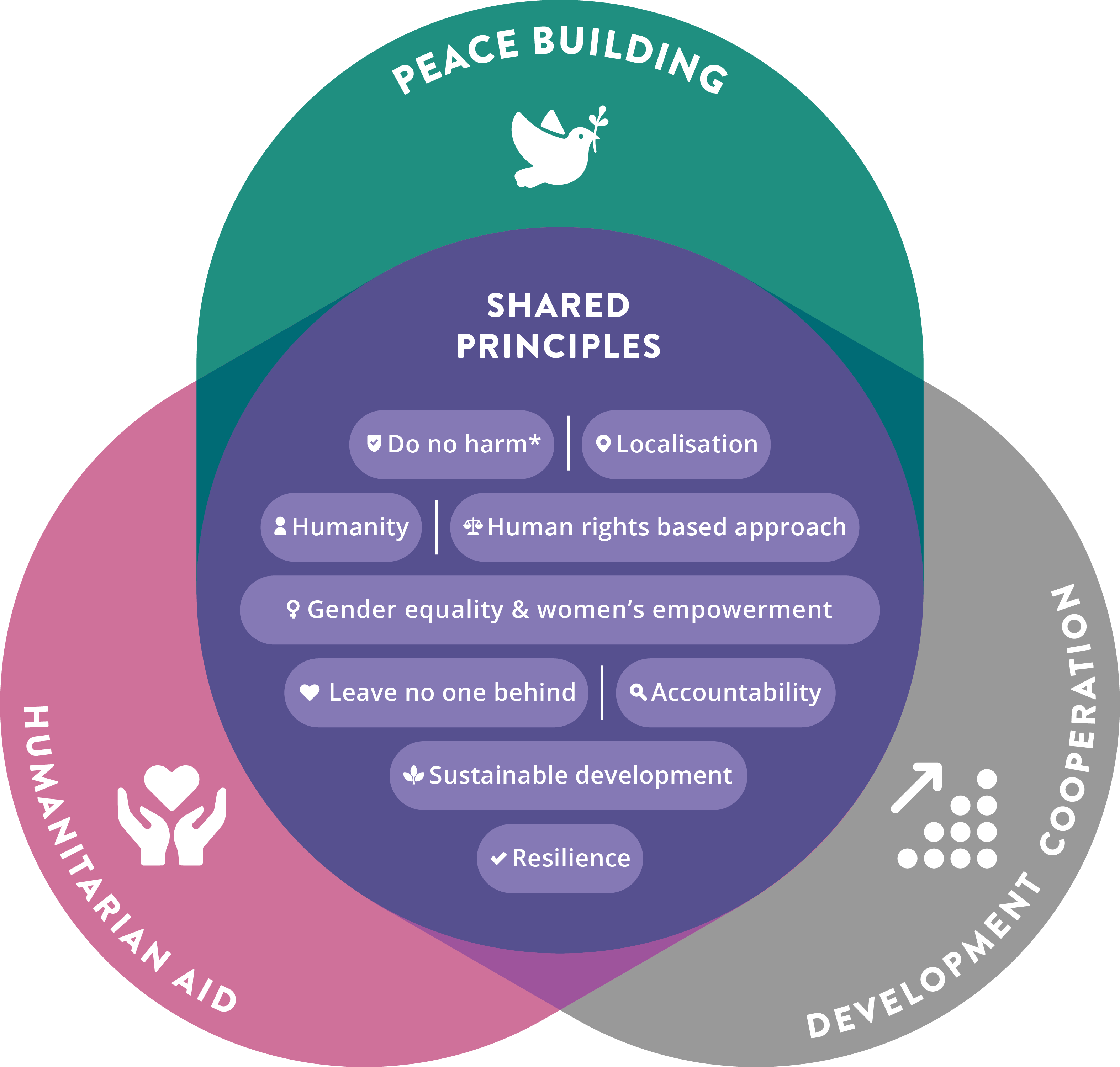
In contexts where people are highly exposed to protracted crises – and where governments are unable to guarantee the human right to sanitation – collaboration between humanitarian, development and peace pillars is the key to building resilienceResilienceAbility of all key sanitation stakeholders to prevent, resist, absorb, adapt, respond and recover positively, efficiently and effectively when faced with a wide range of risks, while maintaining an acceptable level of WASH system performance without compromising long-term…, conflict sensitivityConflict sensitivityAbility of a sanitation agencies to understand its operating context, the interaction between its interventions and the context, and act upon this understanding to avoid negative impacts (“do no harm”) and maximise positive impacts on conflict factors ( UNICEF 2020, IASC 2020b). and peacebuildingPeacebuildingCapacity to “reduce the risk of a lapse or relapse into violent conflict by directly addressing root causes and consequences of conflict,” and to address conflict and “lay and support foundations for sustainable peace and development” capacities within sanitation systems. These capacities are a prerequisite for: addressing and reducing sanitation humanitarian needs over the long term; achieving the sustainable development of sanitation services; and contributing to both minimising harm (do no harm) and building peaceful societies (do more good). Collaboration between silos is feasible. There are several principles that humanitarian and development actors share, thus providing a strong foundation for collaboration based on comparative strength, effective coordination and coherence across all programming phases.
Overview
The HDP nexus is “a means to addressing and reducing people’s unmet needs, risks and vulnerabilities, increasing their resilienceResilienceAbility of all key sanitation stakeholders to prevent, resist, absorb, adapt, respond and recover positively, efficiently and effectively when faced with a wide range of risks, while maintaining an acceptable level of WASH system performance without compromising long-term…, addressing the root causes of conflict and building peace” (Development Initiatives, 2019) Implementing the nexus approach is particularly relevant in contexts prone to protracted (e.g., long term conflict, water insecurity etc.) and recurrent (e.g., floods, drought etc.) crises (IASC 2020a). In such contexts, humanitarian, development and peace pillars collaborate to provide the required stability to implement long-term programmes.
Worldwide, fragilityFragilityThe combination of exposure to risk and insufficient coping capacity of the state, systems and/or communities to manage, absorb or mitigate those risks. Fragility is measured on a spectrum of intensity and expressed in different ways across the economic, environmental,… is expected to increase, driven by rising conflict and megatrends such as climate change, urbanisation, instability, and demographic change. Without resilient sanitation systems, the humanitarian needs in the sector are likely to continue to grow. In 2023 over 90% of all humanitarian funding was spent in protracted crisis contexts. Global sanitation humanitarian appeals remain largely unmet and their funding rate even dropped in recent years.
Systematic application of the HDP nexus is crucial in contexts of protracted and recurrent crisis to achieve more durable and sustainable sanitationSustainable SanitationSustainable sanitation aims to protect and promote human health by providing a clean environment and breaking the cycle of disease. In order to be sustainable a sanitation system has to be socially acceptable, technically and institutionally appropriate, economically viable… solutions that are more cost-effective in the medium to long term. This can contribute to prevent conflicts over water resources and other ecosystem services, improve public health and health care, promote educational opportunities and advance equality by addressing the different needs and vulnerabilities, including of all gender groups and people with disabilities.
The objective of the HDP nexus in sanitation is to minimise negative impacts of shocksShocksShort term deviations with substantial negative effects on people’s current state of wellbeing, level of assets, livelihoods, safety or ability and capacity to withstand future shocks. and maximise sanitation systems performance over the long term, especially in fragile environments. The diagram below shows the reliance of the WASH system performance on the existence of resilienceResilienceAbility of all key sanitation stakeholders to prevent, resist, absorb, adapt, respond and recover positively, efficiently and effectively when faced with a wide range of risks, while maintaining an acceptable level of WASH system performance without compromising long-term… capacities in a particular context, especially when confronted with stressorsStressorsLong term processes or conditions, often related to development and inequality, that influence the level of risk by contributing to exposure and vulnerability or reducing capacities. such as climate change or weak institutions and shocksShocksShort term deviations with substantial negative effects on people’s current state of wellbeing, level of assets, livelihoods, safety or ability and capacity to withstand future shocks. such as conflict or natural disasters (adapted from OECD 2014).
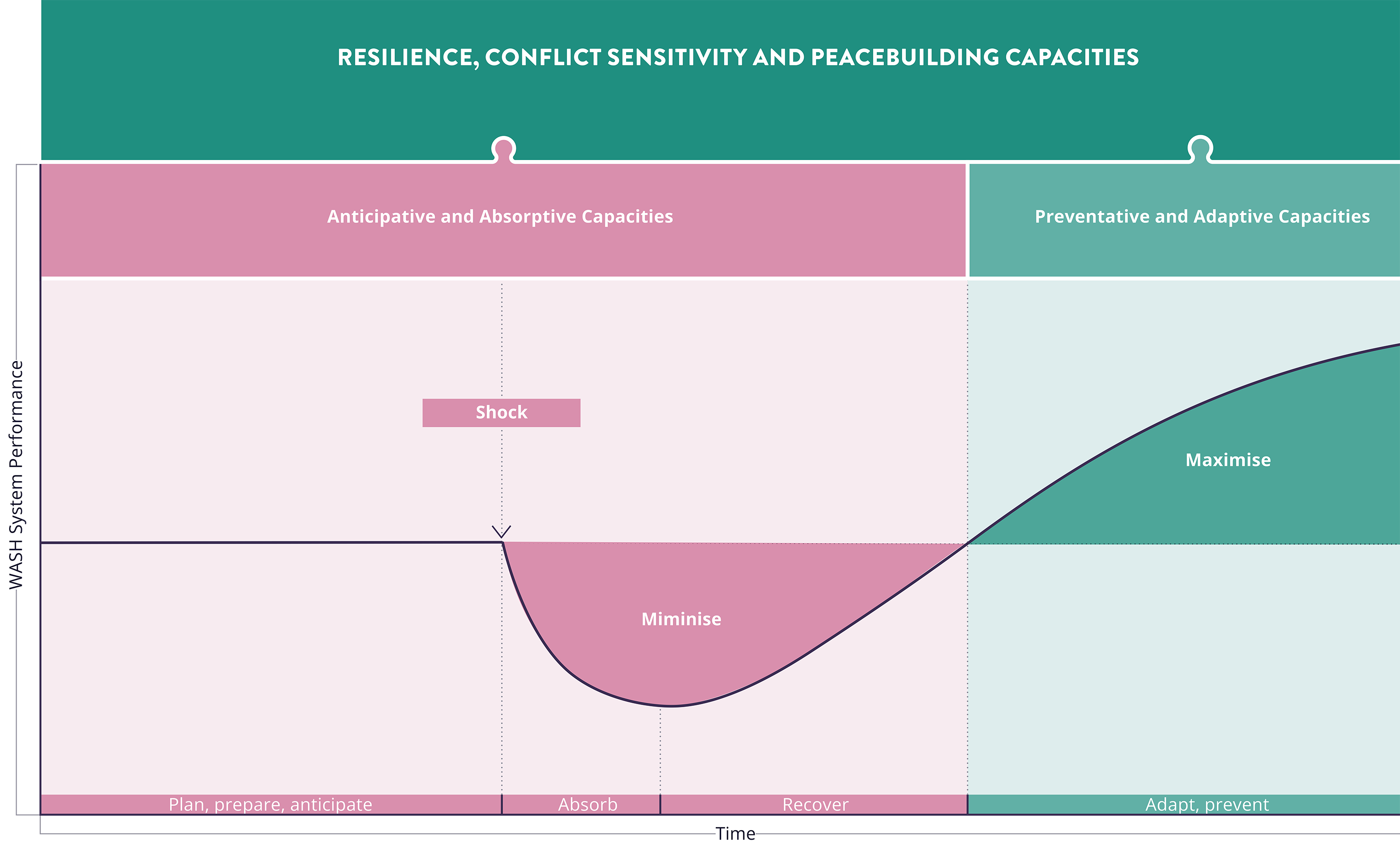
ResilienceResilienceAbility of all key sanitation stakeholders to prevent, resist, absorb, adapt, respond and recover positively, efficiently and effectively when faced with a wide range of risks, while maintaining an acceptable level of WASH system performance without compromising long-term… capacities allow to plan, anticipate and prepare for shocksShocksShort term deviations with substantial negative effects on people’s current state of wellbeing, level of assets, livelihoods, safety or ability and capacity to withstand future shocks. and enable effective absorption and recovery when a shock occurs. “Anticipative and absorptive capacities” try to minimise the negative impact of shocksShocksShort term deviations with substantial negative effects on people’s current state of wellbeing, level of assets, livelihoods, safety or ability and capacity to withstand future shocks. on the sanitation systems performance (in pink). At the same time every shock is an opportunity to learn and adapt or even prevent future shocksShocksShort term deviations with substantial negative effects on people’s current state of wellbeing, level of assets, livelihoods, safety or ability and capacity to withstand future shocks. through risk mitigation. "Preventive and adaptive capacities" therefore aim to maximise the performance of sanitation systems (in green).
To build resilienceResilienceAbility of all key sanitation stakeholders to prevent, resist, absorb, adapt, respond and recover positively, efficiently and effectively when faced with a wide range of risks, while maintaining an acceptable level of WASH system performance without compromising long-term… capacities it is key to adopt a risk informedRisk informedAnalysis of the local context to understand the multiple and interconnected dimensions of risk, including conflict and context specific way of working as a minimum requirement. It begins with an analysis of the local context to understand the multiple and interconnected dimensions of risk, including conflict (UNICEF 2018). This analysis then provides the evidence and direction for building risk-informed capacities such as resilienceResilienceAbility of all key sanitation stakeholders to prevent, resist, absorb, adapt, respond and recover positively, efficiently and effectively when faced with a wide range of risks, while maintaining an acceptable level of WASH system performance without compromising long-term….
The HDP nexus promotes transitioning from temporary and communal facilities to permanent and area-wide sanitation systems serving households, encompassing the whole spectrum of on-site, decentralized and piped-sewage solutions. Only area-wide safely managed systems and related hygiene behaviours enable the comprehensive health impacts of sanitation. Only inclusive, gender-sensitive household solutions can meet the dignity, privacy and safety needs of all vulnerable groups. While the focus in the early stages of an emergency is on containing human excretaExcretaRefers to human excrements consisting of urine and faeces., the priorities in the recovery or long-term response shift to higher service levels, safely managed sanitation and environmental sustainability along the sanitation systemSanitation systemEffective network of people (community) and the systems of which they are a part, operating together to deliver sanitation services (IRC 2022). chain Environmental considerations include the protection of water resources and relevant ecosystems as well as the re-use of treated urineUrineThe liquid produced by the body to rid itself of nitrogen in the form of urea and other waste products. In this context, the urine product refers to pure urine that is not mixed with faeces or water. Depending on diet, human urine collected from one person during one year…, faecesFaecesRefers to (semi-solid) excrement that is not mixed with urine or water. Depending on diet, each person produces approximately 50–150 kg per year of faecal matter of which about 80 % is water and the remaining solid fraction is mostly composed of organic material. Of the total… and waste-water in agriculture.
In fragile and conflict affected contexts also conflict sensitivityConflict sensitivityAbility of a sanitation agencies to understand its operating context, the interaction between its interventions and the context, and act upon this understanding to avoid negative impacts (“do no harm”) and maximise positive impacts on conflict factors ( UNICEF 2020, IASC 2020b). and peacebuildingPeacebuildingCapacity to “reduce the risk of a lapse or relapse into violent conflict by directly addressing root causes and consequences of conflict,” and to address conflict and “lay and support foundations for sustainable peace and development” capacities need to be integrated in the sanitation systems. Conflict sensitivityConflict sensitivityAbility of a sanitation agencies to understand its operating context, the interaction between its interventions and the context, and act upon this understanding to avoid negative impacts (“do no harm”) and maximise positive impacts on conflict factors ( UNICEF 2020, IASC 2020b). capacity is the ability of actors to understand its operating context (i.e., through conflict analysis), the interaction between its interventions and the context, and act upon this understanding to avoid negative impacts (“do no harmDo No HarmBuilding on the recommendation of the conflict analysis, the next step is to ensure a “do no harm” approach “to avoid unintended negative consequences” from the implementation of the WASH programme. According to the Interagency Standing Comittee (IASC) and Sphere this is a…”) and maximise positive impacts on conflict factors like water resources (IASC 2020b). Building preventative and adaptive capacity from a peacebuildingPeacebuildingCapacity to “reduce the risk of a lapse or relapse into violent conflict by directly addressing root causes and consequences of conflict,” and to address conflict and “lay and support foundations for sustainable peace and development” perspective is about ensuring processes and mechanisms are integrated within the WASH system to promote collaboration, inclusionInclusionThe policy and practice of ensuring equal access to opportunities and resources for those who are often excluded or marginalised., and accountabilityAccountabilityThe obligation to demonstrate that work has been conducted in compliance with agreed rules and standards. Sphere describes accountability as the process of using power responsibly, taking account of and being held accountable by different stakeholders and primarily those who are… (Tearfund & UK AID 2014). These can be small steps, such as introducing a feedback mechanism to link the communityCommunityA group of people sharing something in common. and the service provider, or participatory negotiations between different groups to manage water resources or protect relevant ecosystems, or strengthening the individual capacities of women and indigenous groups to participate in the management.
To achieve the intermediate collective outcomesCollective outcomesCommonly agreed measurable result(s) or impact(s) enhanced by the combined effort of different actors, within their respective mandates, to address and reduce people’s unmet needs, risks and vulnerabilities, increasing their resilience and addressing the root causes of conflict”…, it is recommended to adopt a systems approach and integrate resilienceResilienceAbility of all key sanitation stakeholders to prevent, resist, absorb, adapt, respond and recover positively, efficiently and effectively when faced with a wide range of risks, while maintaining an acceptable level of WASH system performance without compromising long-term…, conflict sensitivityConflict sensitivityAbility of a sanitation agencies to understand its operating context, the interaction between its interventions and the context, and act upon this understanding to avoid negative impacts (“do no harm”) and maximise positive impacts on conflict factors ( UNICEF 2020, IASC 2020b). and peacebuildingPeacebuildingCapacity to “reduce the risk of a lapse or relapse into violent conflict by directly addressing root causes and consequences of conflict,” and to address conflict and “lay and support foundations for sustainable peace and development” capacities across five key building blocks of the WASH / sanitation systems:
- Resilient WASH service providers, infrastructure and water resources
- Resilient communityCommunityA group of people sharing something in common. WASH behaviour
- WASH policies, laws, guidance and standards linked
- Coordination, planning, information management linked
- Flexible and sustainable financing
The Joint Operational Framework provides further sample sub-outputs, which give a more detailed information on how the five building blocks can be strengthened in a systematic way.
In summary, there are three main programmatic approaches to the nexus:
- Risk informedRisk informedAnalysis of the local context to understand the multiple and interconnected dimensions of risk, including conflict
- Conflict sensitivityConflict sensitivityAbility of a sanitation agencies to understand its operating context, the interaction between its interventions and the context, and act upon this understanding to avoid negative impacts (“do no harm”) and maximise positive impacts on conflict factors ( UNICEF 2020, IASC 2020b). and peacebuildingPeacebuildingCapacity to “reduce the risk of a lapse or relapse into violent conflict by directly addressing root causes and consequences of conflict,” and to address conflict and “lay and support foundations for sustainable peace and development”
- Systems strengthening
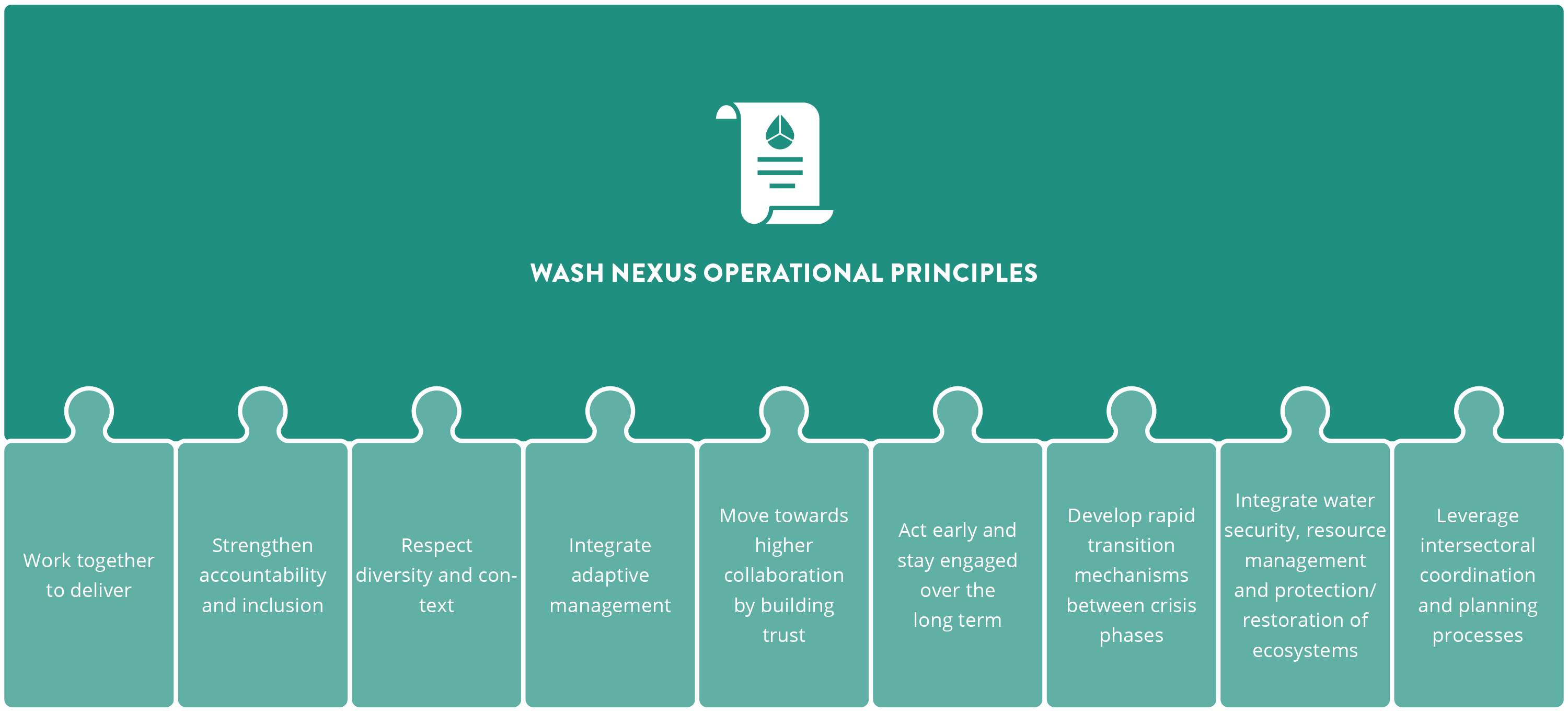
In addition to the programmatic approaches, the “Joint Operational Framework: Building WASH ResilienceResilienceAbility of all key sanitation stakeholders to prevent, resist, absorb, adapt, respond and recover positively, efficiently and effectively when faced with a wide range of risks, while maintaining an acceptable level of WASH system performance without compromising long-term…, Conflict SensitivityConflict sensitivityAbility of a sanitation agencies to understand its operating context, the interaction between its interventions and the context, and act upon this understanding to avoid negative impacts (“do no harm”) and maximise positive impacts on conflict factors ( UNICEF 2020, IASC 2020b). and PeacebuildingPeacebuildingCapacity to “reduce the risk of a lapse or relapse into violent conflict by directly addressing root causes and consequences of conflict,” and to address conflict and “lay and support foundations for sustainable peace and development”” proposes the following operational principles for addressing the Nexus in challenging environments:
Authors
Johannes Rueck (German WASH Network), Lia Volpatti (German Toilet Organization (GTO))
Reviewer
Rob Gensch (German Toilet Organization (GTO))
Bibliography
- Joint Operational Framework: WASH Resilience, Conflict Sensitivity and Peacebuilding (adapted from)
- WASH for Peace Guidance and Tools
- Applying WASH systems approaches in fragile contexts: A discussion paper
- Water Under Fire (Volume 1)
- UN-IASC Light Guidance on Collective Outcomes
- IASC Issue Paper: Exploring peace within the Humanitarian-Development-Peace Nexus (HDPN)
- How WASH can contribute to peace- and state-building
- Humanitarian-Development Coherence in WASH or WRM Program
- Guidelines for Resilience Systems Analysis: How to Analyse Risk and Build a Roadmap to Resilience
- Guidance for Risk-Informed Programming
- Key Questions and Considerations for Donors at the Triple Nexus: Lessons from UK and Sweden