


Inclusive Planning and Participation
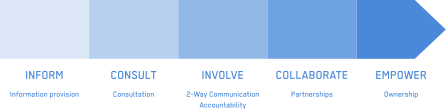
Inclusive planning and participation are key ingredients to achieve sustainability in humanitarian interventions. The approach actively involves and empowers affected communities to regain control over their lives. It also ensures that host communities are informed of any ongoing activities. Inclusive planning helps to ensure that different needs and services along the entire sanitation disposal chain are addressed. There are different levels of participation: inform, consult, involve, collaborate and empower. Participation is an interactive process and incorporates regular feedback loops (‘consult, modify, consult’). Great care should be taken when planning to consider the humanitarian principles of impartiality, neutrality and independence.
Key Actions
- Base the planning processes on consultation, meaningful participationParticipationAims to empower people and involve them in decisions that affect their lives. Inclusive planning and participation are key ingredients to achieve sustainability in humanitarian interventions. They exceed consultation which involves seeking input from stakeholders. The different… and coordination with others, ensuring all the actors from affected communities are represented.
- Seek a dialogue with host communities and assess the scope of their inclusionInclusionThe policy and practice of ensuring equal access to opportunities and resources for those who are often excluded or marginalised..
- Understand what people are currently experiencing, their level of trauma, motivation, capacity and availability to participate. Agree on strengths as well as needs in terms of psychological support or capacity building. Make enough time for building trust, consensus, dialogue and involvement.
- Give feedback to the communityCommunityA group of people sharing something in common. to validate planned activities and crosscheck their perceptions. People cannot participate if they do not have access to information about the response or the opportunity to question and debate it.
- Document decisions and decision-making processes for the Operation and Management Plan and to demonstrate transparency and support Accountability.
- Identify opportunities to hand over control to affected communities throughout the response.
- Employ participatory information-gathering techniques such as Participatory Learning and Action (INTRAC 2017) techniques or visual methods such as Community Mapping.
- Apply demand-responsive approaches to planning and managing inclusive services, e.g. CLUES (Lüthi et al. 2012), the URD Handbook (Group URD 2009), or the Compendium of Hygiene PromotionHygiene PromotionA planned, systematic approach that enables people to take action and encourages behaviours or conditions that prevent or mitigate WASH-related diseases. Hygiene promotion aims to support the dignity and wellbeing of emergency affected populations. Hygiene promotion is… in Emergencies (Gensch et al. 2022 Chapter E).
- Focus on the user interfaceUser InterfaceA term used to describe the type of toilet, pedestal, pan, or urinal that the user comes into contact with; it is the way users access the sanitation system. In many cases, the choice of user interface will depend on the availability of water and on user preferences. and onsite storage (i.e. toilets and single pits or latrines for rapid response) and use the Sani Tweaks approach of ‘consult-modify-consult’. Consult throughout the entire sanitation service chainSanitation Service ChainA Sanitation Service Chain - sometimes also referred to as Sanitation Value Chain - is defined as the combination of technologies and services that in combination manage sanitation products from their point of generation to the point of reuse or disposal. The hardware part of… in the stabilisationStabilisationThe degradation of organic matter with the goal of reducing readily biodegradable compounds to lessen environmental impacts (e.g. oxygen depletion, nutrient leaching). and recovery phaseRecovery PhaseThe recovery phase, sometimes referred to as the rehabilitation phase, aims to recreate or improve the pre-emergency situation of the affected population by increasingly incorporating development approaches and principles. This phase usually starts after, or sometimes during,…. The aim is to ensure that communities develop ownership. The Sani Tweaks project provides five design considerations to address before any latrineLatrineA sanitation facility used for urination and defecation including a 'user interface' and an 'onsite storage pit'. Often interchangeably referred to as toilet. design work is undertaken. For transport, treatment, reuseReuseUse of recycled water or other sanitation products. and disposal, select Appropriate Technologies that fit with local O&M skills, Financial Resources, and Physical Site Conditions.
Relevance/Importance
Inclusive planningInclusive planningInsert description built on participationParticipationAims to empower people and involve them in decisions that affect their lives. Inclusive planning and participation are key ingredients to achieve sustainability in humanitarian interventions. They exceed consultation which involves seeking input from stakeholders. The different… and regular community/stakeholder consultationCommunity/Stakeholder ConsultationCommunity/stakeholder consultation refers to a process of engaging with the individuals or groups that are affected by or have an interest in a particular project or decision. The aim of consultation is to gather input, opinions, and concerns from these stakeholders to inform… is essential because if crisis-affected populations can use their capacities and help to define the solutions their needs are more likely to be met.
The Sphere Handbook (Sphere Association 2018) also emphasises the importance of inclusive planningInclusive planningInsert description: “Ensure representation is inclusive, involving the participationParticipationAims to empower people and involve them in decisions that affect their lives. Inclusive planning and participation are key ingredients to achieve sustainability in humanitarian interventions. They exceed consultation which involves seeking input from stakeholders. The different… and engagement of communities and people affected by crisis at all stages of the work. Give attention to groups or individuals historically excluded from power and decision-making processes”. Inclusive planningInclusive planningInsert description should also consider host communities to ensure equity and identify opportunities to address general needs along the humanitarian-development nexus.
People’s level of engagement will depend on their motivation and capacity to engage as well as the opportunities given to participate. The crisis-affected population will not be all the same and it is vital to understand the differences that exist as well as the factors that separate and unite people. Working with existing communityCommunityA group of people sharing something in common. organisations can increase their engagement; key individuals from communityCommunityA group of people sharing something in common. organisations can act as representatives for others, broadening the scope of inclusionInclusionThe policy and practice of ensuring equal access to opportunities and resources for those who are often excluded or marginalised.. Strengthened communityCommunityA group of people sharing something in common. bonds can enable the affected population to collaborate with or lead the emergency response in partnership with response teams.
Overview
Involving affected communities is crucial in all phases of the response.
At the beginning of an emergency, people need vital information about how to protect themselves and where to get help (inform). However, there is always time to ask people about what they need and as time goes on, this consultation should broaden and deepen to help shape Sanitation programme activities (consult). Early consultation can be a better use of time than making inappropriate decisions later. In the early stages of an acute response, consultation might only be possible with limited numbers of affected people. Over time, there will be more opportunities for more people and groups to become involved in decision-making. But even at the start of an emergency there will be opportunities to involve people in making decisions about e.g. the design of facilities and to provide feedback about the programme (involve). As communities begin to organise, they can choose to partner with responders, taking the initiative and proposing improvements (collaborate). Empowerment is usually seen as the highest level and involves communities working collectively to gain control over their lives and make decisions.
Source: HP Compendium
Consider various methods to enhance community engagementCommunity EngagementConnects the community and other stakeholders so that people affected by crisis can participate and have more control over the response and its impact on them., including communityCommunityA group of people sharing something in common. scorecards, communityCommunityA group of people sharing something in common. mapping or focus group discussions (Gensch et al. 2022 Chapter T). Any truly inclusive planningInclusive planningInsert description process should follow the planning phases outlined below (Groupe URD 2009):
- Understand the dynamics and structures within the communityCommunityA group of people sharing something in common. (communityCommunityA group of people sharing something in common. mapping of management structures).
- Initiate the project design: who needs to be involved, who will manage the process, and who has decision-making power? Discuss the selection criteria and details of who will benefit from the programme.
- Create an inclusive task force that represents all members of a target communityCommunityA group of people sharing something in common..
- Discuss and prioritise possible solutions and ensure that the solutions are specific and implementable.
- Encourage dialogue between people of concern and surrounding populations/host communities to develop joint activities based on common goals and interests, thereby fostering peaceful coexistence.
- Produce an action plan that includes activities, resources and responsibilities.
- Mobilise from planning to implementation: mobilise resources, mobilise participationParticipationAims to empower people and involve them in decisions that affect their lives. Inclusive planning and participation are key ingredients to achieve sustainability in humanitarian interventions. They exceed consultation which involves seeking input from stakeholders. The different… for project implementation and implement the action plan.
- Evaluate the planning process and document the results.
The resources provided (see right column) give a step-by-step approach on how to plan with rather than for communities.
Authors
Christoph Lüthi (Swiss Federal Institute of Aquatic Science and Technology (Eawag)), Sara Ubbiali (Swiss Federal Institute of Aquatic Science and Technology (Eawag)), Dorothee Spuhler (Swiss Federal Institute of Aquatic Science and Technology (Eawag))
Reviewers
Rob Gensch (German Toilet Organization (GTO)), Andrew Bastable (Oxfam)
Bibliography
- The Sphere Handbook: Humanitarian Charter and Minimum Standards in Humanitarian Response. 4th Edition
- Participation Handbook for Humanitarian Field Workers
- Compendium of Hygiene Promotion in Emergencies
- Closing the Loop – Effective Feedback in Humanitarian Contexts
- Oxfam's Water, Sanitation and Hygiene Promotion Resources – Running Programms: Urine Diversion Dehydration Toilet
- Participatory Learning and Action Plan (PLA)