


Shit Flow Diagram
A Shit Flow Diagram (SFD), also referred to as an excreta flow diagram, is a tool used to readily understand and communicate how excreta ‘flows’ through a city, town or refugee camp. An SFD helps to visualise how human excreta is, or is not, managed safely as it moves from defecation via containment, transport and treatment to its final disposal or end-use. In a humanitarian context, an SFD can facilitate a gap identification and strategising process carried out with stakeholders and WASH cluster partners.
Key Actions
- Determine the purpose and scope of the diagram: this includes deciding on the specific geographical area to be mapped, the level of detail required and the stakeholders who will be using the diagram (or sharing the information and data to enable others to produce an SFD.
- Collect data: the required data includes the total volume of excretaExcretaRefers to human excrements consisting of urine and faeces. (this can be assumed by using the figure of the total population) and the proportional volume that is divided into the different technologies used for containment, emptying, transport, treatment and disposal or reuseReuseUse of recycled water or other sanitation products.. This data can be gathered through site visits, surveys and interviews with WASH practitioners working on the site or from external experts. In many emergency contexts, few technologies are used, so obtaining this data is easier than it sounds.
- Develop a draft diagram: based on the data collected, create a first draft of the diagram, using the online SFD software.
- Review and refine: Share the draft diagram with stakeholders and obtain feedback. Use the feedback to refine the diagram, making changes as necessary to ensure accuracy and completeness. For a fast and more general meta level SFD, the review and refine step may not be essential.
- Finalise the diagram: once the diagram has been reviewed and refined, create a final version that can be used for planning, design, and evaluationEvaluationThe systematic and objective examination of a humanitarian intervention to determine the worth or significance of an activity, policy or programme and intended to draw lessons to improve policy and practice and enhance accountability. The key evaluation criteria are relevance,… purposes.
Relevance/Importance
The purpose of an SFD is to provide a clear and comprehensive overview of the strengths and weaknesses of the entire excretaExcretaRefers to human excrements consisting of urine and faeces. management process in a given camp, village, settlement or city. An SFD shows the current management practices of each step of the sanitation service chainSanitation Service ChainA Sanitation Service Chain - sometimes also referred to as Sanitation Value Chain - is defined as the combination of technologies and services that in combination manage sanitation products from their point of generation to the point of reuse or disposal. The hardware part of… so that deficits in infrastructure and management practices across the whole system are highlighted and any environmental and public health risks are made visible.
SFDs can help WASH cluster partners and other stakeholders including local authorities to better understand and discuss the current sanitation situation, identify areas of improvement in the sanitation systemSanitation SystemA sanitation system is a context-specific set of technologies, which in combination manage sanitation products from the point of generation to the point of use or ultimate disposal along the five functional groups of the sanitation service chain. A viable system is one that is…, prioritise interventions and make informed decisions about the allocation of resources. In addition, the tool ensures that the full sanitation chain is included in the discussion and resulting sanitation strategy.
Overview
An SFD shows which parts of the sanitation service chainSanitation Service ChainA Sanitation Service Chain - sometimes also referred to as Sanitation Value Chain - is defined as the combination of technologies and services that in combination manage sanitation products from their point of generation to the point of reuse or disposal. The hardware part of… are safely managed (using green arrows) and which are unsafely managed (using red arrows).
An SFD will be different in each context but it most often indicates the need for better onsite containment and faecal sludgeSludgeMixture of solids and liquids, containing mostly excreta and water, in combination with sand, grit, metals, trash and/or various chemical compounds. A distinction can be made between faecal sludge and wastewater sludge. Faecal sludge comes from on-site sanitation technologies,… management along the sanitation service chainSanitation Service ChainA Sanitation Service Chain - sometimes also referred to as Sanitation Value Chain - is defined as the combination of technologies and services that in combination manage sanitation products from their point of generation to the point of reuse or disposal. The hardware part of…. Below is a typical SFD for the Domiz refugee camp in the Kurdish region of Iraq.
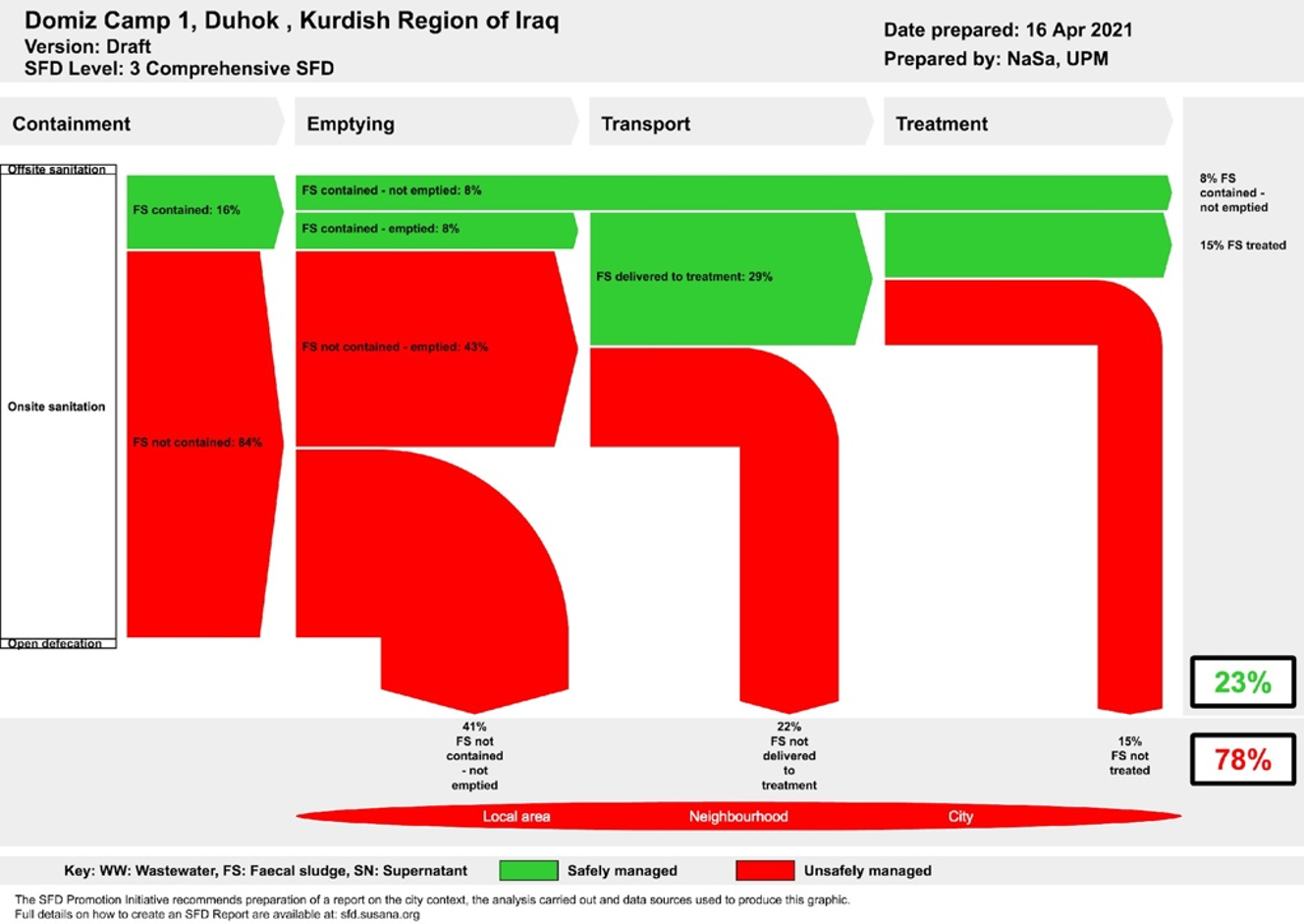
Example SFD from a Camp in the Kurdish Region of Iraq
Once data has been collected, an SFD can be produced using the free online graphic generator at the SFD Portal which guides the user through the steps to input the data, generate an SFD and download the results:
- Go to the SFD website: download the offline SFD software for your operating system (Windows, Mac, or Linux).
- Launch the SFD software: click on the icon graphic generator and then click on ‘Start new SFD graphic’.
- Enter the data: use the input fields provided in the software to enter data about the geographic area.
- Choose an SFD level: the SFD software has a range of templates for different levels of detail to match the available data and the diagram’s intended use. Choose the template that best fits your needs. In emergency settings - particularly for camp contexts - a less detailed ‘SFD lite’ approach can be used to speed up production, even if only basic information is available.
- Create the diagram: once the data has been entered, click on the ’Generate SFD’ button to create the SFD diagram. The software will generate a visual representation of the excretaExcretaRefers to human excrements consisting of urine and faeces. flow which can then be downloaded.
The SFD can then be used for analysis, decision-making, and communication on excretaExcretaRefers to human excrements consisting of urine and faeces. management issues.
The SFD portal provides many additional resources for those interested in learning more about SFDs and their use in sanitation planning and management. A standard template for an SFD report is also available, providing details on assumptions and an interpretation of the results. The portal encourages users to produce this report and share it on its website.
Author
Catherine Bourgault (Center for Affordable Water and Sanitation Technology (CAWST))
Reviewers
Dorothee Spuhler (Swiss Federal Institute of Aquatic Science and Technology (Eawag)), Marij Zwart (Netherlands Red Cross (NLRC)), Rob Gensch (German Toilet Organization (GTO)), Andy Peal (Shit Flow Promotion Initiative)
Bibliography
- SFD Promotion Initiative (adapted from)
- The Missing Link in Sanitation Service Delivery. A Review of Faecal Sludge Management in 12 Cities
- Fecal Sludge Management (FSM): Analytical Tools for Assessing FSM in Cities
- Estimating Safely Managed Sanitation in Urban Areas. Lessons Learned From a Global Implementation of Excreta-Flow Diagrams